Guide · Choosing a printable game
Escape room or treasure hunt? How to pick for your kids
In a treasure hunt, each clue sends kids to a hiding place where the next clue waits, so the game is mostly searching and moving. In an escape room, kids solve puzzles that give codes, and each code opens the next step of a story, so the game is mostly decoding and logic. Choose a picture-clue treasure hunt when the youngest player is 4 to 7 or can't read yet, or when kids need to burn off energy. Choose an escape room when every player can read short instructions on their own (usually 8 and up) and the group can sit at one table.
Side by side
| Treasure hunt | Escape room | |
|---|---|---|
| What kids do | Read or look at a clue, go to the place it shows, find the next clue | Solve a puzzle, get a code or word, check it, open the next part of the story |
| Core skill | Searching, recognising places, following a trail | Decoding, logic, reading instructions, teamwork at a table |
| Youngest age to play without an adult | About 4, if clues are pictures | About 8; 6 and 7 year olds can play with an adult solving alongside |
| Reading and math | Little or none for picture hunts; riddles and codes for 8+ and 12+ | Reading instructions, simple math, logic grids, ciphers |
| Space | Several rooms, or a house and yard | A table; some games also hide envelopes around one room |
| Setup | Hide each clue where the one before it points; the order matters | Put each puzzle in a numbered envelope; read the host guide and answer key |
| Ending | A prize you choose at the last hiding place | The final code solves the mystery or “unlocks” the escape |
| Best for | Birthdays, little kids, burning off energy, mixed ages where older kids help | Family game night, classrooms, tweens and teens, rainy days at the table |
| Not ideal for | A crowd in a small apartment; kids who want a challenge to think about | Pre-readers on their own; very short attention spans |
This compares the two formats in general, whoever made the game. Free, paid and homemade versions all follow the same patterns.
The decision rule
- Look at the youngest player who will play without an adult.
- Can't read yet, or under 7: a treasure hunt with picture clues.
- Can read two-sentence instructions alone (usually 8+): either format. Pick a hunt for energy and space, an escape room for puzzles and a table.
- Mixed ages, such as 5 and 10 together: a treasure hunt, with the older kids reading clues aloud. An escape room only if an adult sits with the younger ones.
- More than about 6 kids: either, but split into teams of 3 to 5 with one set of clues or puzzles each.
Pick by the youngest player
- Ages 4 to 7
- Treasure hunt with picture clues. Each clue is a drawing of the next hiding spot, so children who can't read can lead. Escape rooms at this age only work with a grown-up solving alongside.
- Ages 8 to 10
- Either. A riddle hunt if they have energy to burn, an escape room if they like puzzles. Mixed 6- and 10-year-olds do better with a hunt: the older ones read, the younger ones run.
- Ages 10 to 13
- Escape room, or a hunt with coded clues so every stop needs a puzzle solved first.
- Teens and adults
- Escape room or mystery game. A murder mystery party fits a bigger group where each guest plays a character.
Pick by the situation
- Birthday party, 8+ kids
- Treasure hunt, one set of clues per team of 3 to 5, each hidden in a different part of the house or yard. Ten kids at one escape-room table is too many.
- Christmas Eve or a rainy day
- Escape room: it keeps a small group at the table for an hour or more without much running.
- Classroom
- Escape room, one set per team of 3 to 5. A hunt around a classroom works for kindergarten if you hide clues in fixed spots.
- Gift reveal
- Treasure hunt that ends at the present. Coded hunts make the reveal last longer for older kids.
Free, homemade or paid?
- Homemade
- A picture treasure hunt is easy to make: draw or photograph 6 to 10 hiding spots and hide each picture at the spot before it. It costs nothing and works well for ages 4 to 6.
- Free printables
- Teacher blogs, Pinterest and Teachers Pay Teachers have free one-page hunts and short puzzle sets. Good for trying the format; they are usually short and may not include hints or an answer key.
- Paid printables
- From a few dollars to about $20 on Etsy and independent shops. You usually get a full story, a longer set of puzzles, a host guide, hints and an answer key, ready to print the same day.
Before you start
- Hiding spots: skip the oven, stairs, high shelves and anywhere with medicine or cleaning products. Tell kids which rooms are out of bounds.
- Printing: most printables work in black and white; color mainly matters for color-coded puzzles, which the listing should mention.
- Attention span: plan roughly 30 to 45 minutes for ages 4 to 6, up to an hour for 7 to 9, and longer for older kids and adults.
Examples from Aimee Studio
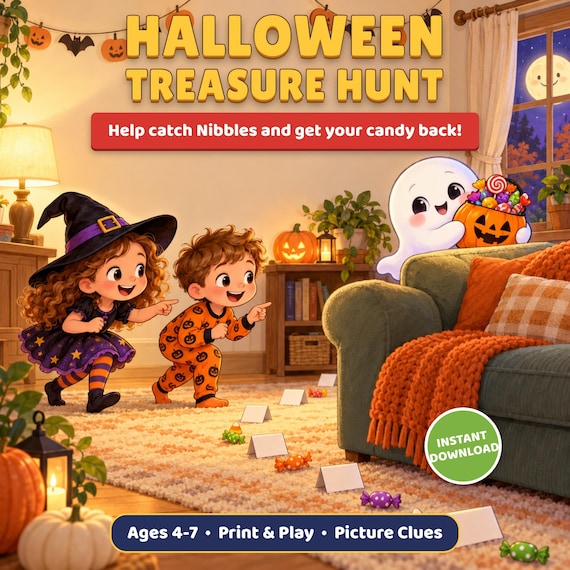 Hunt · ages 4–7Nibbles' Candy Chaseages 4–7 · 1–6 · 45–75 min
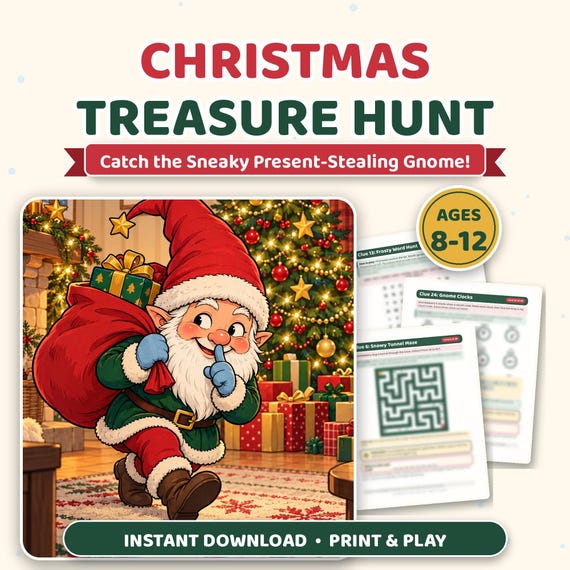 Hunt · ages 8+Grumbleberry's Christmas Treasure Huntages 8–12 · 1–6 · 2–2.5 hours
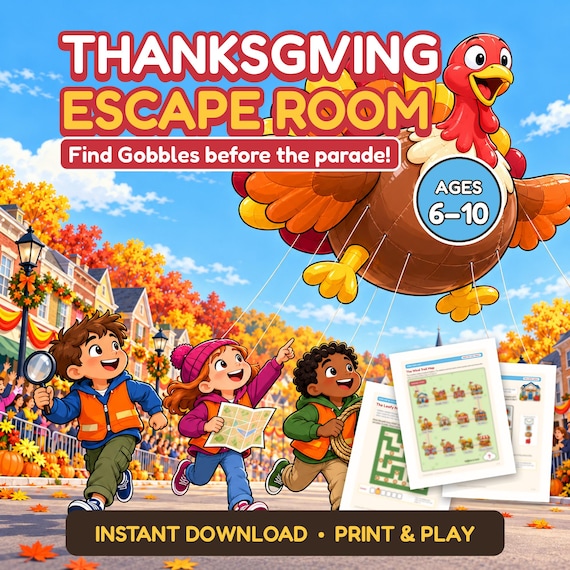 Escape room · ages 6–10Thanksgiving Turkey Puzzle Adventureages 6–10 · 2–6 · 60–90 min
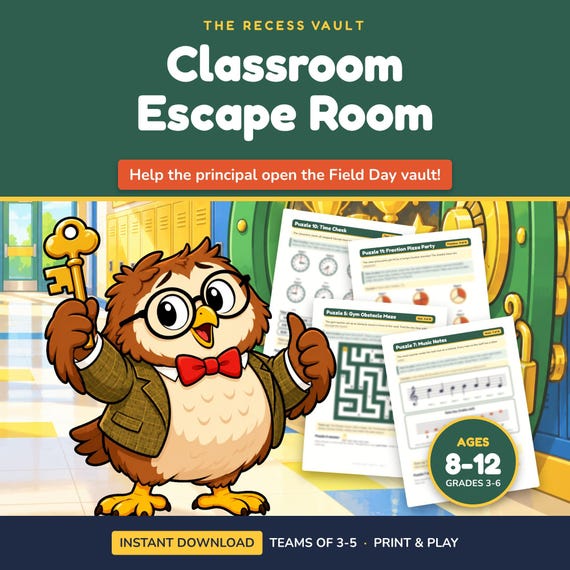 Escape room · ages 8–12The Recess Vaultages 8–12 · teams of 3–5 · 60–90 min
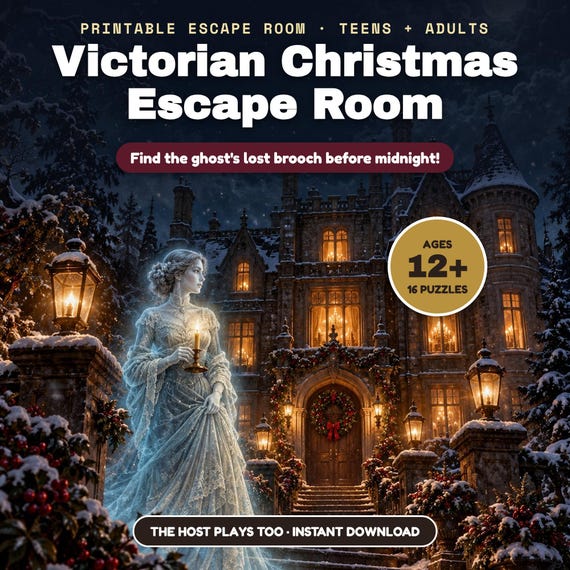 Escape room · teensGhost of Wintergrave Manorages 12+ · 2–6 · 60–90 min
Questions
What is the difference between an escape room and a treasure hunt?
In a treasure hunt each clue points to a hiding place where the next clue is waiting, so players move around. In an escape room players solve puzzles that give codes, and the codes move a story forward; it can be played at one table.
Which is better for a 5-year-old?
A treasure hunt with picture clues. Five-year-olds can follow pictures of hiding places without reading. Printable escape rooms for this age need an adult solving with them.
Which is better for a 10-year-old's birthday?
For a small group that likes puzzles, an escape room. For a big group or kids with lots of energy, a treasure hunt with riddles or coded clues, one set per team.
Can I combine the two?
Yes. A coded treasure hunt does both: each clue is a puzzle, and the answer says where to look next.
Do I need locks or boxes?
No. Printable escape rooms check answers on paper or with the host, and treasure hunts only need the clue cards and a prize.
How long does each take?
A picture-clue hunt for little kids usually takes 30 to 60 minutes. Coded hunts for older kids and printable escape rooms usually take 45 minutes to 2 hours. Check the play time on the game you pick.
Are there free versions?
Yes. Free one-page hunts and puzzle sets are on teacher blogs, Pinterest and Teachers Pay Teachers, and a picture hunt is easy to make yourself. Paid printables add a full story, hints and an answer key.