Party ideas · Birthday · Ages 9–12
Birthday Party Ideas for Kids 9–12: 12 At-Home Ideas Tweens Actually Want
Tweens are the hardest age to throw a party for: too old for little-kid games, too young for a teen hangout, and quick to call anything “babyish”. Look at what actually works — the parties parents write about, the formats party sites recommend year after year — and a pattern emerges: keep them busy with things they can DO together. Competitions in 60-second bursts, food they make themselves, a hunt or a challenge with a real finish line, and for sleepovers, a second act after dinner. Here are the 12 ideas that come up most often for ages 9–12, with notes on cost, prep and group size. The main event we would plan the rest around is an escape room birthday party, built on a printable escape room for kids you print and run at home.
Minute-to-Win-It party
The most-recommended at-home format for this age, full stop. A list of 60-second challenges with household items — stack cups, move cookies from forehead to mouth without hands, balloon relay, marshmallow tower — scored on a whiteboard across the whole party. Silly, loud, zero cost, and it fills every gap between bigger activities.
a timer, a challenge list, household props, a scoreboard.
An escape room birthday party (the main event)
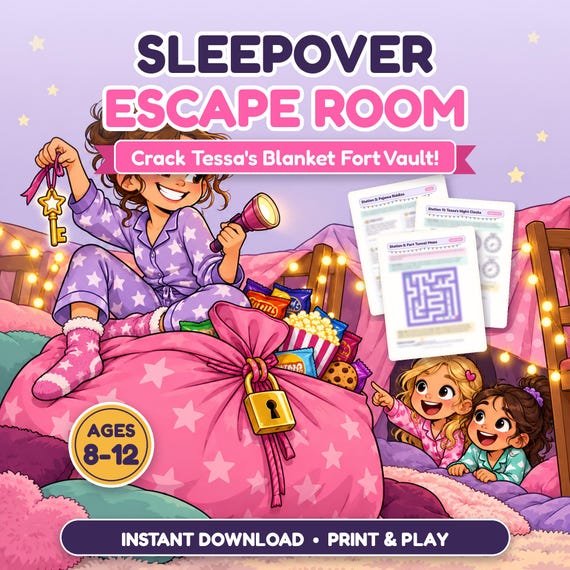
Party guides for tweens now list an “escape room challenge” as a headline idea — book a venue, or run one at home. The at-home version with a printable escape room for kids skips the venue price and the travel: you print the game, hide the clues, and the living room becomes the room. An escape room birthday party works as the main event because it gives the whole group one mission for a full hour instead of five-minute bursts.
A ready-made example is our birthday escape room The Blanket Fort Vault (ages 8–12, 1–6 players, 60–90 minutes): big sister Tessa has locked the midnight snacks in her Blanket Fort Vault, and the crew cracks 11 puzzles before breakfast to get them back. Build the fort before guests arrive — cushions, blankets, string lights — and play inside it; the finale opens onto real snacks.
the printed game, a fort, snacks as the prize. One team, one table (or one fort).
Bake-off / decorate-your-own dessert party
Personal pizzas, cupcake decorating judged like a baking show, or a full bake-off with joke awards (best rise, best disaster, most ambitious). Tweens take cooking seriously at this age, the activity is the food, and nobody has to be entertained while things bake — that is what idea 1 is for.
bases (pizza dough or plain cupcakes), toppings and icing, aprons if you are brave.
Craft stations they rotate through
Tie-dye shirts, friendship bracelets, slime with mix-ins, painted tote bags or pillowcases. Stations beat one big craft: guests drift, make something at their own pace, and take it home as the party favour. Set this up as the arrival activity — it absorbs the first awkward twenty minutes completely.
2–3 craft setups, one take-home item per guest.
Scavenger hunt / Amazing Race at home
Split into teams, hand over clue envelopes, and send them around the house and garden: photo challenges, riddles, silly tasks filmed on a phone. An Amazing Race format (checkpoint → challenge → next clue) keeps it competitive for a full hour. For a ready-made version, printable treasure hunts do the clue-writing for you — our treasure hunt guide compares picture-clue, riddle and code hunts by reading level, so you can match the hunt to your group.
clue envelopes or a printed hunt, phones for photo challenges, a small prize per team.
Game night tournament
Board games, card games and one video-game bracket, run as a tournament with a silly trophy. Mix fast classics (Uno, Jenga) with one longer game, seed the bracket so everyone plays several rounds, and let the birthday kid be the trophy presenter. Works especially well for smaller, quieter groups.
3–4 games, a bracket on paper, a trophy (the sillier the better).
Sleepover games: a mystery after dinner
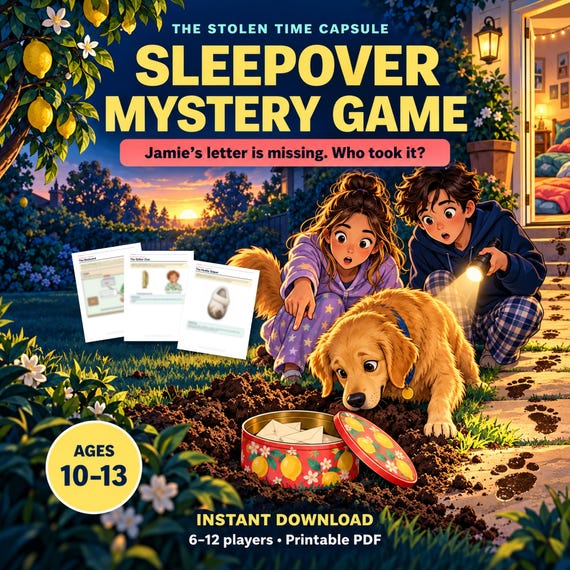
If the party becomes a sleepover, you need a second act — this is where most sleepover games fail, because they are over in ten minutes. A mystery game where the guests ARE the suspects runs the whole evening: our Sleepover Mystery Game (ages 10–13, 6–12 players, 60–90 minutes) has someone dig up the time capsule and take Jamie's letter, and the guests play the suspects and argue it out. As girl sleepover games go, it is the rare one that is mostly conversation — accusations, alibis and dramatic reveals — which is exactly what this age wants after dinner.
6–12 guests, a dinner break before it starts. Evening slot.
Carnival booths for a bigger group
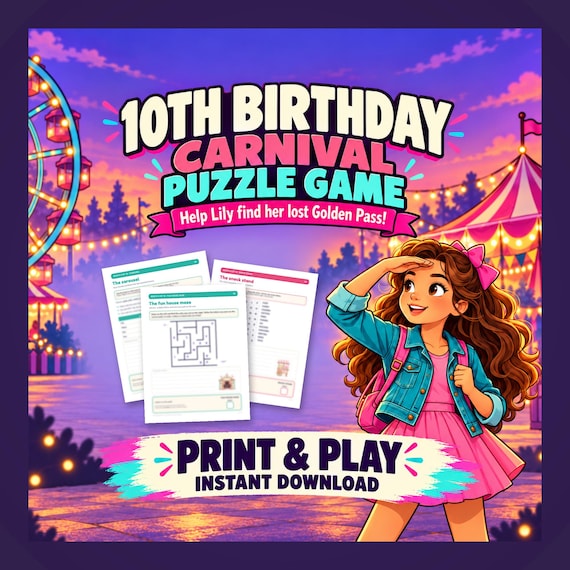
Too many guests for one team around one table? Run booths. Our Starlight Carnival Puzzle Adventure (ages 8+, 1–8 players, 30–50 minutes) is built that way: the wind has snatched Lily's Golden Pass, and players solve ten carnival booths and unscramble the answer to win it back. Set the booths up as stations, add two or three real ones (ring toss, tin can alley), and let small groups rotate. It is also the shortest main event here — the pick for a party with a hard end time.
stations around one room, small groups rotating.
Movie night sleepover (or sleepunder)
The classic for a reason: a film the group votes on, a popcorn bar with mix-ins, sleeping bags in a fort (see idea 2 — the fort is already built). For guests not staying over, a “sleepunder” ends at 10pm with the same programme. Put the movie last; it is the wind-down, not the party.
a film, popcorn bar, blankets and pillows.
DIY spa night
Face masks, nail painting, hair braiding, cucumber water in fancy glasses. Feels grown-up, costs very little, and pairs well with idea 9 — spa first, movie after. Keep it to stations so nobody waits.
masks, nail polish, towels, a playlist.
Karaoke / dance party with a glow twist
A playlist of their songs, a cheap microphone, glow sticks after dark. Add structure or it fizzles: a dance contest judged by the birthday kid, a karaoke bracket, or freeze-dance rounds between songs.
speaker, playlist, glow sticks, room to move.
Photo booth + fort den for the gaps
A backdrop, props on sticks, and a phone on a tripod. Tweens will entertain themselves with this for longer than any planned game — set it up at the start and let it run all party. The photos double as thank-you messages the next day.
backdrop (a sheet works), props, tripod or a stack of books.
A running order that uses the list
- Arriving · 20 min
Craft stations (4) and photo booth (12) open.
- First hour
Minute-to-win-it rounds (1) interleaved with the bake-off (3).
- Main event · 60–90 min
The escape room (2), or carnival booths (8) for a bigger group.
- Cake + tournament final
Game night bracket (6) finishes with the trophy.
- Sleepover only
Mystery (7) after dinner, spa (10), movie (9) last.
Short on time? Ideas 1 + 2 + cake is a complete two-hour party on its own.
Resources: where to find more ideas
The best party ideas are usually borrowed. These are the sites we read when we plan — including, in the interests of honesty, our own corner of the internet:
- YourTeenMag — birthday and party ideas written specifically for tweens and teens, including at-home and budget formats.
- Party Parrot — big practical guides to kids' party planning by age, theme and budget, with cost estimates.
- OKC Mom — real at-home tween parties written up by a parent, minute-to-win-it and Amazing Race formats included.
- ModernMom — birthday games for tweens: scavenger hunts, relays and outdoor games.
- Aimee Studio (us) — printable games for this age group: the escape room for kids collection, treasure hunts and mystery games on our kids games page, all instant PDFs you print at home.
Questions
How many ideas do I need for a two-hour party?
Three or four: one arrival activity, one quick game format, one main event, cake. The list is a menu — the running order above shows two ways to combine it.
What if I only buy one thing?
Make it the main event. A printable escape room for kids covers a full hour with one print run; everything else on this list can be done with things already in the house.
How many guests can the escape room take?
The Blanket Fort Vault plays 1–6 as one team. For more guests, use the carnival booths (idea 8) or run a treasure hunt in teams (idea 5).
Can I use these games in a classroom?
Yes — one purchase covers your own household or one classroom or group, and you can print what your group needs.